
Midnight Thoughts
What I thought about while simultaneously painting an all-nighter.

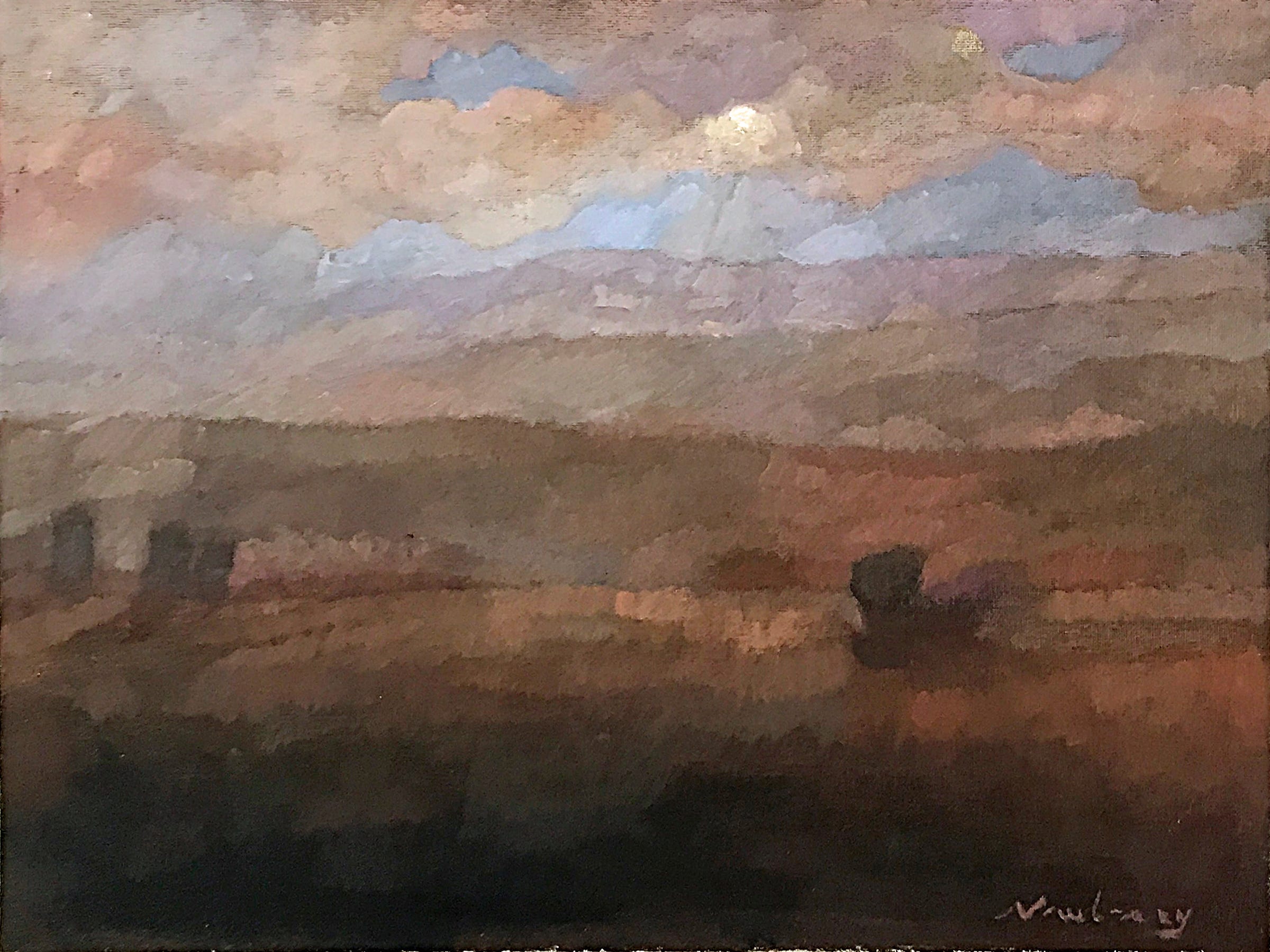
I’ve recently discovered the pianist François Joël Thiollier and have been listening to his several-volume work on Debussy, while at the same time seeing a fascinating Yale professor, Magnus Resch, on LinkedIn talking about the economic and institutional leverage of art, and last night, while pulling an all-nighter painting until 7 a.m. and making inspired breakthroughs [isolating highlights, and light and dark middle tones, into abstract organic shapes like a jigsaw pieces, set my figure in motion, hence giving her stance the emotion I was looking for] I found myself contemplating the nature of existence, art, and the art world.
The contemporary art world of the last 70 years is a house of cards. It survives by not defining art clearly, and that vagueness is a safeguard. On Linkedin there are art world people who try to define it in positive terms, but they can’t be specific or clear. Like religion, contemporary art relies on belief, ritual, and institutional authority rather than something that can be understood and perceptual. When common sense or analysis is applied, it retreats into the unknowable and treats that as an answer, even though that isn’t an answer worthy of artistic passion. This makes the art world and postmodern art extremely vulnerable, even if a lot of money and belief are invested in it.
I trace this back to Kant’s concept of the sublime, which I see as elevating the incomprehensible, the formless, and what violates cognition over beauty, perception, and the senses. Kant treated beauty as a second-class concept and positioned the sublime as superior to art itself, with art being the enemy to what he was trying to get across. His concept of the sublime is about trying to comprehend the incomprehensible, and reason cannot be based on non-perception, so there is no real place for reason there. What he was justifying aesthetically was nihilism, and that philosophical premise gave later art institutions and intellectuals the greenlight to pursue senselessness, even if most people don’t understand Kant explicitly, it’s similar to how religious premises work.
My position is that art is the catalyst and guardian of modern human cognition. Figurative art is a concrete that integrates perception, emotion, and thought, and that integration did not come first; it emerged through the process of making art, starting with the first artworks around 40,000 years ago. This is embedded in human cognition, which is why even three- and four-year-olds draw figurative things like houses, the sun, and their parents. Postmodern art (anything and nothing) destroys this integration and is therefore a pseudo-art. Instead of being based on cognition, its value comes from things like auction house prices, museum exhibitions, media validation, and institutional support, while no one examines what the actual value of the artwork is in cognitive terms.
Kind of wild … when you suppress the perceptual and material you wind up with a system supported by the most base of materialistic institutions!